Teaching Equivalent Fractions Through a Student-Designed Story
In this equivalent fractions story activity, two characters get identical garden plots. One plants half of hers; the other splits his into four equal parts and plants two. Students draw both models, explain why 1/2 and 2/4 cover the same area, and only then write the story. Reject any model where the plots are different sizes or the parts are unequal.
By ArtifyTales Team, Nell AI Labs LLC · Published · 7 min read
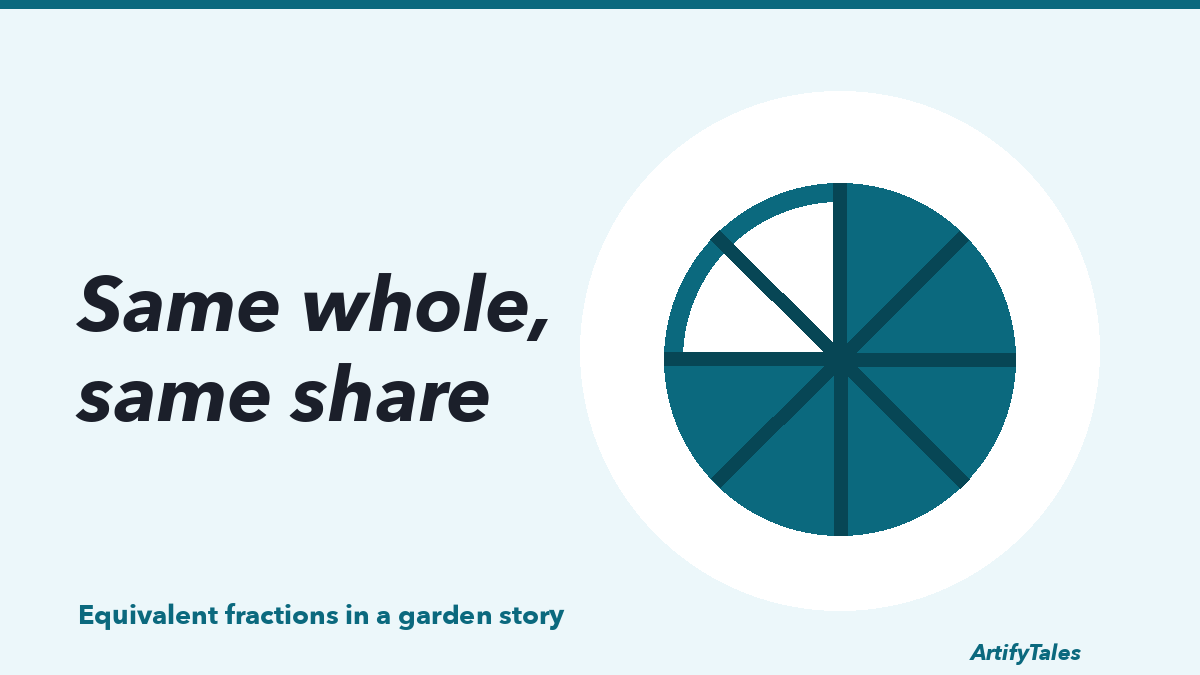
A student looks at 1/2 and 2/4 and says, with total confidence, “Two-fourths is bigger. Two is bigger than one, and four is bigger than two.” It is a reasonable guess from the numbers alone, and it is one of the most common fraction misconceptions in Grades 3 and 4.
An equivalent fractions story activity can fix it, but only if the picture is right. Equivalent fractions need equal wholes and equal-sized parts. A charming story about a garden will not repair a misleading drawing, so in this lesson the model comes first and the story comes last.
| What a teacher needs | This activity |
|---|---|
| Time | 45 minutes |
| Prep | Grid paper, two identical rectangles per student, colored pencils |
| Grouping | Model in pairs, explain individually, write individually |
| Student output | Three fraction models, a one-sentence explanation, a short story, an exit answer |
| Assessment | Equal wholes, equal parts, and an explanation of why the shaded areas match |
The math students must get right
Put these on the board before anyone draws:
- Same whole. Two fractions can only be compared when they are fractions of the same whole. Both plots must be identical.
- Equal parts. Fourths means four equal-sized parts. Four parts of different sizes are not fourths.
- Why 1/2 = 2/4. Cutting each half into two equal pieces makes four pieces, each half the size. Two of those smaller pieces cover exactly what one half covered.
- Same point on the number line. On a line from 0 to 1, 1/2 and 2/4 land on the same point.
In Common Core terms this is 3.NF.A.3 (explaining and generating simple equivalent fractions with visual models). Fourth graders meet the general version in 4.NF.A.1, which asks why multiplying the numerator and denominator by the same number gives an equivalent fraction.
The lesson, step by step
- Set up the plots (5 minutes). Give each pair two identical rectangles: Ana’s garden and Leo’s garden. Say it out loud: “These plots are exactly the same size.”
- Model 1/2 and 2/4 (10 minutes). Ana splits her plot into 2 equal parts and plants carrots in 1. Leo splits his into 4 equal parts and plants carrots in 2. Students shade both.
- Compare and explain (10 minutes). Students lay the plots side by side, or fold one over the other, and write one sentence: 1/2 and 2/4 are equal because… Ask them to explain the equivalence before any story writing begins.
- Add a third model (5 minutes). Grandpa splits the same plot into 8 equal parts and plants 4. Students shade it and place all three on a number line from 0 to 1.
- Write the story (10 minutes). Now the characters can argue about who planted more. The story has to reach the correct answer, and the explanation sentence has to appear in it.
- Exit question (5 minutes). On their own, students draw two identical wholes to show whether 2/3 and 4/6 are equal.
A worked example you can check
Here is an illustrative story, the kind a third grader might write; it is not real student work.
Ana and Leo each got a garden plot 8 feet long. Ana split hers into 2 equal parts and planted carrots in 1 part. Leo split his into 4 equal parts and planted carrots in 2 parts. “I planted more,” said Leo. “I have two parts!” Ana measured. Her carrot part was 4 feet long. Each of Leo’s parts was 2 feet long, so his two parts were 2 + 2 = 4 feet. “Same!” said Ana. “Your parts are smaller, so you needed two of them.”
Check the math the way the class will. Half of 8 feet is 4 feet. A fourth of 8 feet is 2 feet, and two fourths is 4 feet. For Grandpa’s 4/8, each eighth is 1 foot, and four eighths is 4 feet. All three are 4 feet of carrots out of the same 8-foot plot, so 1/2 = 2/4 = 4/8. The story reaches the right answer, and the key sentence (“your parts are smaller, so you needed two of them”) is the explanation you are assessing.
What to reject, and why
Reject any model where the plots are different sizes, even if the story is lovely. If Leo’s plot is bigger, his 2/4 really is more carrots, and the student has just “proved” that 2/4 is greater than 1/2. Also reject fourths drawn as four unequal strips. Send the drawing back with one question: “Are all the parts the same size?”
A useful second check is the one-sentence explanation on its own. A student who writes “They are the same because the parts are half as big, so you need twice as many” understands. A student who writes “They are the same because the teacher said so” needs another round with the model before the story.
Why the story comes last
When students write the story first, they often draw a picture to fit it, and the picture bends. When the model comes first, the story has to agree with something that is already true. The argument between Ana and Leo is also the misconception, said out loud by a character, which lets students correct it without anyone being wrong in front of the class.
This is the same check-the-story approach used across our K–8 math and science story ideas, including the Grade 5 fractions activity. If you want to test whether your version produces evidence you can mark, the four questions in how to check whether a story activity meets your lesson objective apply to math as well as writing.
Where ArtifyTales fits
Once the model and explanation are done, a student can photograph their drawing or type their story as a script, and ArtifyTales can turn it into an illustrated story. It works from the student’s own story, and the teacher decides what the task requires.
Then have students check the illustrated version against their model. Are the plots the same size in the pictures? Are the parts equal? Generated stories and illustrations can get fractions wrong, so a teacher reviews every one before it is shared, and the student’s model and explanation stay the evidence you assess.
Student work and privacy
Drawings and written work are student data. Read how ArtifyTales handles children’s drawings and voices and our FERPA and student data commitments first, and get privacy, retention and deletion terms in writing before a school pilot. Keep full names, school names and addresses out of shared stories.
Frequently asked questions
- What do students need to understand before an equivalent fractions story?
- That a fraction names equal-sized parts of a whole, and that two fractions can only be compared when they refer to the same whole. Check both with a quick drawing before the story begins. Without them, the story will hide the misunderstanding rather than fix it.
- Why must the two garden plots be the same size?
- Equivalent fractions describe the same amount of the same whole. Half of a big plot is more ground than half of a small plot, so if the plots differ, the comparison stops being about fractions. Students should draw identical rectangles and say so in their explanation.
- How do I know a student really understands 1/2 = 2/4?
- Ask them to explain it without the story: “Why do two of four parts cover the same area as one of two parts?” A good answer mentions that the parts are half the size, so it takes twice as many. A number line showing both at the same point is further evidence.
- Which fractions should Grade 3 students use?
- Common Core Grade 3 limits fractions to denominators of 2, 3, 4, 6 and 8, which covers 1/2, 2/4, 4/8, 1/3, 2/6 and 2/3, 4/6. Grade 4 extends to fifths, tenths, twelfths and hundredths.
- Does every student need to draw for this activity?
- Yes, in this case, because the model is the math. The drawing does not need to be neat, but the rectangles must be the same size and the parts must be equal. Grid paper helps.
- What is a good exit question for equivalent fractions?
- Use a new pair the story did not include, such as “Draw a model to show whether 2/3 and 4/6 are equal.” Students who can partition two identical wholes and compare the shaded areas have transferred the idea.
- Can ArtifyTales check the fractions in a student’s story?
- No. Treat any generated story as something the class checks. A story can describe unequal parts or different-sized plots without noticing, so students compare the illustrated version with their own model, and a teacher reviews it before sharing.
Try one lesson, then talk to us
Run the garden-plot lesson once and read the explanation sentences; they will show you who understands equivalence. See how ArtifyTales turns a child’s drawing into an animated story.
For classrooms and learning centers we build custom plans, including shared avatar pools, multi-student accounts and printable activity packs. Request a school or institution pilot and tell us your grade and group size.
The Kindergarten–Grade 8 Common Core ELA alignment sets out the literacy side, and FERPA and student data covers what a district review will ask for.