How to Turn a Child’s Scribble Into a Magical Story
To turn a scribble into a story, ask the child what they see in it, photograph the shape without fixing it, give it a name and something it wants, introduce one small problem, and let the child decide how it responds. A scribble is not a failed drawing — it can be a map, a monster, a storm, or a doorway.
By ArtifyTales Team, Nell AI Labs LLC · Published · 8 min read
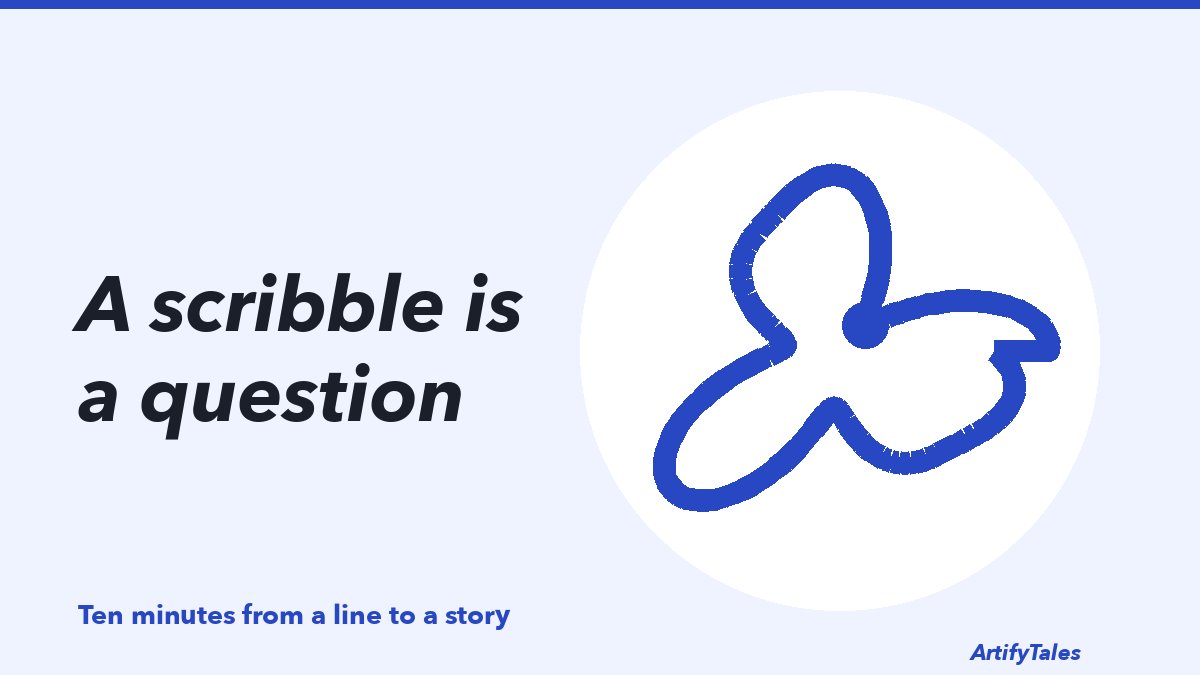
“It’s just a scribble” is something adults say and children rarely do. To the child, the page usually already is something — a map, a monster, a storm, a nest, a language, a machine, a doorway. The work is not to improve the drawing. It is to ask.
The scribble game
Paper, something to draw with, five to ten minutes.
- Ask for one continuous scribble.
- Rotate the page, all four ways.
- Ask: what could this be?
- Add only the details the child asks for.
- Name the character or the place.
- Ask what it wants today.
- Introduce one obstacle.
- Let the child tell or draw the ending.
There are no wrong interpretations, including the ones that change halfway through.
Questions that open a story
Avoid “what did you draw?” — it implies the child was supposed to know in advance, and a surprising number of them will then make something up to satisfy you. Better:
- What does this shape remind you of?
- Where is it going?
- What sound does it make?
- Is it tiny, enormous, or can it change size?
- Who is its friend?
- What happened five minutes before this picture?
- What is hidden inside the loops?
Pick two or three. Seven in a row is an interview, and children can tell.
Turn the answer into a profile
Say the child sees a storm creature called Zigga:
Keep the plot to three parts
Beginning: the character and what it wants. Middle: something goes wrong and it tries something. End: it succeeds, learns, repairs, or discovers. The child can say it out loud while an adult writes it down — dictation is authorship, and it removes handwriting as a barrier entirely.
Bringing the scribble in
Photograph the page clearly, or redraw it on the digital canvas. ArtifyTales can read the image as the blueprint for an illustrated avatar with a name and personality. Pick a theme and an art style, make the story, and then review it with the child on their terms: does it still feel like Zigga? Is the golden eye important? Should the ending change?
From there it can become narration, music, video, a cinematic clip, colouring pages, games, or print-ready art. The wider method is in turning a drawing into a personalized storybook.
Protect the imperfection
The adult instinct is to smooth the lines, balance the shapes, and make the creature more recognisable. Pause before doing any of it. The ambiguity is precisely what let the child invent — a tidy drawing has already decided what it is.
Keep a photograph of the original scribble and consider putting it on the last page. The journey from mark to meaning is the most interesting thing in the book.
Six extensions with no screen involved
- Make a second scribble for the character’s friend.
- Build the setting from blocks or recycling.
- Move like the character, across the room.
- Invent a theme song.
- Draw three emotions using only lines.
- Ask another family member what they see in the same shape.
The last one is worth doing at least once. Watching an adult see something completely different in their scribble tells a child something about interpretation that no explanation will. More ideas of this kind are in the parent’s guide to better screen time, and what fits each stage in creative activities by child-development stage.
Frequently asked questions
- What age is the scribble-story activity for?
- It works best in the preschool and early primary years, but older children and adults use the same game as an improvisation or writing warm-up. The mechanism — ambiguity invites invention — does not expire.
- Does the child need to explain the scribble?
- No. An adult can offer two neutral possibilities and let the child pick, or the child can supply just a name, a feeling, or a sound. Any one of those is enough to begin a story.
- Can ArtifyTales work with very simple drawings?
- Yes. A scribble can be used as the source, and photos, digital drawings, spoken descriptions, scripts, and handwritten story pages are all accepted as alternatives.
- What if my child changes their mind about what it is?
- Let them. A creature that turns out to be a map halfway through is a plot development, not a mistake, and children who are allowed to revise their interpretation tend to keep inventing for longer.
- Should I add details to make the scribble clearer?
- Only the ones the child asks for. Every line you add on your own initiative narrows what the shape can still become, and the ambiguity is what is doing the work.
- What if two children see different things in the same scribble?
- Make both. Two stories from one shape is the best possible demonstration that the interpretation, not the drawing, is where the story comes from.
- How long should this take?
- Five to ten minutes for the game, and stop while it is still fun. The story can be made later the same day or not at all — the scribble game is worth doing on its own.
- Can this help a child who says they cannot draw?
- It is close to the ideal activity for that child, because a scribble cannot be done badly. The skill being exercised is invention, and the drawing is deliberately taken out of the running as something to fail at.
A line can become a world
Next time a page looks like “only a scribble”, rotate it, ask one curious question, and wait longer than feels comfortable. See how ArtifyTales turns a child’s drawing into an animated story.
ArtifyTales is available on iPhone and iPad and on Android.